
DFF funds four research projects at Department of Neuroscience
Professor Nanna MacAulay, Professor Ole Kiehn, Professor Martin Fredensborg Rath and Associate Professor Claire Francesca Meehan recently received funding from the Independent Research Fund Denmark.
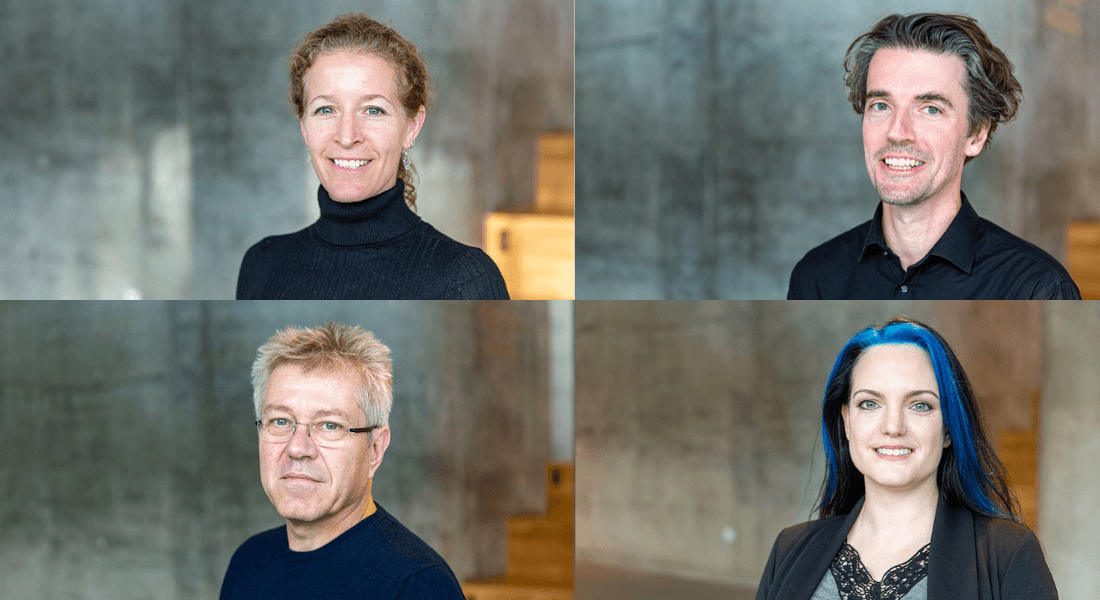
This year, 27 projects based at the Faculty of Health and Medical Sciences received funding from the Independent Research Fund Denmark under the call “DFF-Research Project 1”. Four of them were from the Department of Neuroscience.
Martin Fredensborg Rath: Circadian rhythms in the brain: Can 24h rhythmic infusion of glucocorticoids restore local brain clocks to counteract depressive behaviour in a rodent model?
The circadian system enables the brain to synchronise body functions to the day-night cycle of utmost importance to human health. The main circadian clock is in the suprachiasmatic nucleus of the hypothalamus and controls daily rhythms in glucocorticoid hormones. Our recent progress suggests that 24h rhythms in glucocorticoids act to control the circadian function of the hippocampus. Clinical and experimental findings further show that disruption of the circadian function of the cerebral cortex and hippocampus can elicit depression. We here aim to bridge the gap between neuroscience, psychology, and psychiatry with the purpose of determining if clock rhythms in leukocytes can be used to monitor circadian misalignment and to establish if rhythmic infusion of glucocorticoids in a 24h schedule can reestablish circadian function of the brain to counteract the development of depression.
Ole Kiehn: Reframing basal ganglia circuitry control of locomotion and therapeutic avenues for restoration of gait disturbances in Parkinson’s
This project explores how the basal ganglia control walking movements through their interaction with brainstem motor circuits. While the basal ganglia are known to regulate movement, their precise role in gait remains unclear. Building on our lab’s discovery of brainstem centres for movement initiation, stopping, and turning, we will map basal ganglia–brainstem connections, identify neural patterns that drive locomotion, and apply this knowledge to improve treatments for Parkinson’s gait disorders.
The grant has postdoc Giacomo Sitzia in our lab as a co-applicant.
Nanna MacAulay: Crossing the first barrier – identification of the choroid plexus basolateral transport mechanisms initiating CSF secretion.
My FSS-funded project centres on the cerebrospinal fluid (CSF) that protects the brain from impact and facilitates the transport of nutrients and hormones. CSF disturbances can lead to elevated intracranial pressure (ICP), as observed in e.g. stroke and hydrocephalus, which is currently treated by invasive neurosurgery with associated complications. Pharmacological approaches towards pathological brain fluid accumulation are therefore of high clinical priority. This project will reveal the contribution to CSF secretion of the transport proteins on the vascular-facing side of the choroid plexus, where they can be targeted by systemic drugs. The PhD student will employ in vivo determination of CSF dynamics in mice following pharmacological inhibition or choroid plexus-specific viral knockdown of select transport proteins, complemented by ex vivo determination of their involvement in human choroid plexus organoids. With a lack of specific pharmacological options for elevated ICP treatment, these results could provide a step towards medical treatment of these disorders.
Claire Francesca Meehan: Shining a light on inhibitory control in Amyotrophic Lateral Sclerosis: The elusive chandelier cell.
Topics
DFF-Research Project 1
DFF-Research Project 1 supports independent, researcher-initiated research across all scientific disciplines.
A DFF-Research Project 1 is characterised by having “a clear and well-defined research question where the research activities are expected to be of a high, international level of quality.”
Independent Research Fund Denmark received 1,801 applications for DFF–Research Project1.
DKK 558.3 million has been awarded to 182 projects.
Source: Independent Research Fund Denmark